Why is a Raven Like a Writing Desk? by Chris Green
The tall stranger in the Duster overcoat appears out of nowhere. He is wearing a broad-rimmed sheriff’s hat complete with campaign cord and silver star. A strange getup. This is a sleepy West Somerset coastal resort, not Washington County. Perhaps he feels the hat makes him look interesting. Will help him get noticed.
‘What do you think it is that makes things happen?’ he asks.
At first, I think he must be talking to someone else, but there are just the two of us here. Who is he? What does he mean? Why is he asking me this? I am just enjoying a quiet moment watching the tide come in. It is the school holidays. Spring. The waves are huge.
‘Do you mean, in the big scheme of things?’ I ask,
‘Yes,’ he says. ‘If you like. In the big scheme of things.’
‘We elect people to represent us and they pass laws and other people in other countries do the same,’ I say, trying hard to remember the explanation our Ethics teacher, Mr Jenkins, came up with. ‘We agree with the way some countries do things but not the way other countries do things, and according to relative size and strength, we form alliances and trading blocks. Sometimes there’s a disagreement over ideology and then a war and one side vanquishes the other and makes them do what they want.’
‘Very good!’ the stranger says. ‘But that’s on a political level. That’s what the history books tell you happens. That’s what you read in the papers. That’s surface detail.’
‘Well, some see a different man in the sky to others and they fight about whose man in the sky is the best,’ I say, trying to inject a little humour into the exchange.
‘Indeed!’ he says. ‘But how does it all work on a practical level? What are the mechanisms?’
‘There are improvements in technology and new inventions that bring about change,’ I say. ‘But I suppose innovations are primarily to sell new products to make investors rich.’ Old Josh Jenkins told us this was the principal reason there were technical advances. To fuel capitalism, the money needed to move around faster and faster, he had said. Other than this, new technology was often developed to win wars.
‘That’s how it all works, is it?’ the stranger says.
‘It’s cause and effect,’ I say. ‘Action and reaction. All certainty in our relationships with the world rests on the acknowledgement of causality, wouldn’t you say?’
‘That’s what you’ve been told, is it?’ he says. ‘That determinism explains everything? All I can tell you for now is there’s more to it. One day, you will find out.’
With this, he takes his leave, presumably off to do some surprise sheriffing somewhere else. I can’t help wondering who he is, why he is there and what he means. I am sixteen. What is the purpose of him putting me on the spot? Is he a conspiracy theorist? New World Order and the Seven Sisters? Is he talking about magic? Lord of the Rings and all that mumbo jumbo? Uri Geller and spoon-bending? Or is he just a smartass?
I mention the episode in passing to Roger and Keith before we go off to smoke a spliff or two and listen to Pink Floyd, but I don’t labour the point. At sixteen, you don’t dwell on things for long. The curious encounter is soon forgotten.
Stovepipe hats have not been fashionable since the nineteenth century. So it is strange to come across a man wearing a shiny black one in Vivary Park in Taunton, especially in the middle of a heatwave. 1990 is turning out to be the hottest year on record. Following a minor misunderstanding, Tamsin has gone off to stay with her mother in Madeira for a few days and I am taking our Irish Setter, Bono, for a walk when the tall stranger appears. I can’t take my eyes off him. In his tall hat, he looks completely out of place. It is not even a Lloyd George style topper, it is a proper vintage Victorian stovepipe. Apart from the hat, he is dressed unseasonally, wearing one of those long overcoats. The overall effect is to make him look like a giant. To cap it all, he is carrying a black violin case. He approaches me and strikes up a conversation.
‘Don’t you recognise me?’ he says.
It suddenly occurs to me this is the same fellow I met on the beach all those years ago. He has the same faraway look in his eye, the same pallor to his skin, making it seem almost translucent. There is no mistaking him. I tell him I remember him.
‘Have you worked it out, yet?’ he asks.
I try to recall our earlier conversation. I am not sure what I was supposed to have worked out.
‘You thought everything could be explained by causality,’ he says.
‘Actions, ideas, even things we put down to synchronicity can probably all be explained by cause and effect,’ I say.
‘As in a sequence of events, you mean?’ he says. ‘Chain reaction, butterfly effect.’
‘That’s right,’ I say. ‘All action and reaction.’
‘Action and reaction, eh? That’s Newton’s Third Law, isn’t it,’ he says. ‘And you think you can apply that to everyday life?’
‘More or less,’ I say. ‘Things chug along from day to day, one thing follows another in your chain reaction.’
‘Things chug along?’ he says. ‘H’mm That’s an interesting view.’
‘Everything is loosely connected and each thing that happens affects many others, so what we have is a complex web of actions and reactions,’ I say.
He wants to up the stakes.
‘What about when a seismic event takes place?’ he asks. ‘Something, for instance, like the Berlin Wall coming down last November. Can that be explained by cause and effect? Action and reaction?’
‘I would say that is a classic example of cause and effect,’ I say, rising to the challenge. ‘The East was poor, the West was rich. People in the East were finding this out and wanted some of it. The Soviet Union was losing its grip. Gorbachev was liberalising the Party and freedom groups all over the Eastern bloc were taking advantage of this. Poland, Hungary, Czechoslovakia. With forces chipping away at East German institutions, it was only a matter of time before the Wall fell. It was the final step in a chain reaction.’
‘I’m afraid you are falling into the trap again,’ he says ‘Like you did the last time we spoke. You are just looking at the surface detail. To understand the way things work, you will need to dig deeper.’
Bono, meanwhile, has run off behind the bandstand to investigate another dog. He has an unfortunate habit of doing this and not coming back. I go over to put him back on the lead. When I return, the stranger has disappeared. I can hear a violin playing Lucy in the Sky with Diamonds, softly in the distance.
The encounter leaves me perplexed. Who is the mysterious stranger? Why has he picked me? Am I perhaps just one of many unsuspecting people he tries to convert? But convert to what? What exactly is his message? Is he trying to say in his cryptic way that everything is pre-determined? Or that there is a hidden force, an all-powerful master of the universe? He is certainly peculiar, but somehow he doesn’t come across as a religious zealot. I cannot imagine him calling door to door on a Saturday morning with an associate and a handful of thin pamphlets promising to put you on the path to salvation. Perhaps we are back with magic and the supernatural, and he is suggesting the actual driving force for everything that happens is something mystical. Perhaps he is trying to tell me I need to familiarise myself with some arcane Oriental wisdom in order to transcend the mundane. But what is it about hats?
Each time I see someone wearing an unusual hat, I think it might be him. Bandanas, deerstalkers, turbans. Coonskins caps, fezes, zuchettos. In the street, at concerts, at the races, everywhere. Carnival parades are the worst. But as months go by with each sighting turning out not to be him, the memory of him fades.
I have all but forgotten him when, around the time of the millennium, he appears again, this time in the Science Museum in Kensington. He is dressed in a black damask robe and a mortarboard. It is a lighter conversation than our previous ones. Moving on from the passing of time, we talk about the walrus and the carpenter and cabbages and kings. We touch on Cheshire cats and mad hatters. Do I realise Lewis Carroll was a mathematician and his work is full of hidden meanings, he wonders? I tell him I have always thought he was writing about drugs. ‘
‘Why is a raven like a writing desk?’ he asks.
I wonder if perhaps he has the answer to the age-old riddle, but at this moment, Tamsin returns from her visit to the Natural History Museum next door and he disappears. I get the impression that beneath his bold exterior, he is rather shy.
We are back on the topic of the driving forces behind world events at our meeting in the bar of The Jolly Slaver. It is the year of the smoking ban. I have just come back inside after a cigarette when the stranger accosts me. He is wearing a superhero cape and a wizard’s hat. He wonders if I realise yet that things are never what they seem. The discussion about what lies beneath carries over to our next meeting at the Queen’s Golden Jubilee celebrations in Glastonbury, Somerset. He is wearing a tricolour beanie hat with his white suit. I think he may be disappointed that I do not appear to always understand what he is trying to tell me.
He is always vague about what exactly his role is. His explanations for everything are frustratingly cryptic. Each time he appears, I want to ask him why he has selected me. Why does he keep coming back? But each meeting is inadvertently cut short. Time, in the abstract sense, seems to be a subject that keeps coming up in our brief exchanges. He keeps pressing me on what I think time is? I have always had an unusual perception of time. I frequently have to ask people what the order of past events is. When did we do this, when did we do that? Have we done this before that? More often than not, I appear to get it wrong. Tamsin is forever correcting my apparent temporal discrepancies, suggesting I ought to keep a diary. My historical record frequently seems out of synch with that of others. If I am like this now, I sometimes worry about what I will be like when I am older.
‘You keep referring to cause and effect,’ he says, the next time we meet.
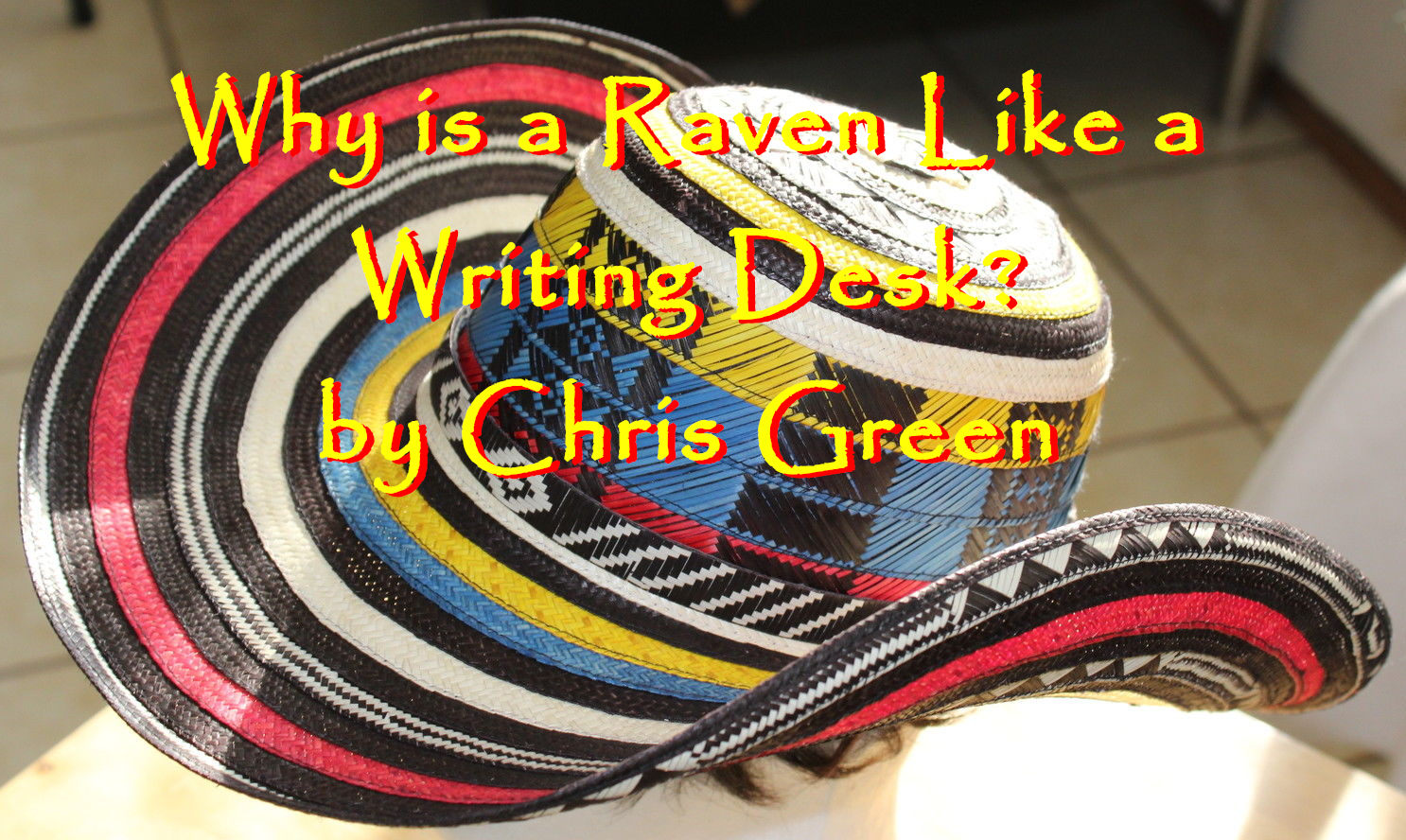
It is in the dining car on the Orient Express. Tamsin is resting back in our carriage. He comes and sits beside me. He is wearing a sombrero vueltiao and big black sunglasses.
‘These chains of events, if that’s what you want to call them, can be unimaginably complex,’ he continues. ‘With so many crazy people in the world behaving irresponsibly, things can easily spiral out of control.’
I agree there are some volatile leaders. In my view, most politicians are dangerous. It seems to go with the job.
‘Without appropriate intervention, the world would have been blown to pieces by a catastrophic event by now many times over,’ he says. ‘I am one of a group of quantum gnostics whose aim it is to prevent such calamities escalating. We operate in the margins. It is our job to correct the course of rogue chains of events. Frequently, we are called upon to do so retrospectively in order to keep the boat afloat.’
Is he referring to specific events or is he generalising? Is he suggesting that he is able to go back in time? I don’t get the chance to find out, as before I have the chance to ask these questions, Tamsin comes looking for me and the stranger ups and leaves.
‘Who were you talking to?’ Tamsin asks.
I try to explain but she does not seem to be listening. She is more concerned with finding out what was on the menu.
Following the meeting on the Orient Express, I begin to question whether time is, in fact, linear. The stranger has planted a seed of doubt in the conventional wisdom of a timeline where a series of events progresses regularly from beginning to end. Certainly, my perception of time is not linear. It has never been like that. I am all over the place with times and dates. I discover I have some backup for the idea. Einstein’s General Theory of Relativity suggests that there is no conceptual distinction between past and future, let alone an objective line of now. Also, he argues there is no sense in which time flows. Instead, all space and time is just there in an elaborate four-dimensional structure. Furthermore, apparently, all the fundamental laws of physics works essentially the same, forward and backward.
If this is the case, then does this also put the very idea of cause and effect into question? If there is no objective flow of time, might causality also work backwards, effect now becoming cause? Or like Lewis Carroll’s Mad Hatter and March Hare, having fallen out with Time, might we too be stuck at 6p.m. forever? The very concept of time might, of course, be an illusion. Everything might be happening simultaneously, with or without interventions and corrections by quantum gnostics. Everything that has ever been and ever will be could be happening right now.
There are so many ways of looking at it, I don’t see what is really going on in the cosmos ever becoming clear to me. Reality itself is a slippery concept. All things considered, it seems reasonable to assume strangers turned out in whimsical headgear are likely to appear anytime, anywhere.
Copyright © Chris Green, 2025: All rights reserved
Mad Hatter: ‘Why is a raven like a writing-desk?’
‘Have you guessed the riddle yet?’ the Hatter said, turning to Alice again.
‘No, I give it up,’ Alice replied: ‘What’s the answer?’
‘I haven’t the slightest idea,’ said the Hatter’
Lewis Carroll

 Chris Green Stories
Hi Chris
Just to say I thoroughly enjoyed this story. I’ve got to admit, I don’t usually get around to reading them (though I always keep them in my inbox). I will now make a pact with myself, to read them when they come into my inbox, and check out the others I’ve saved.
Thanks for sending them.
Best wishes
Bonnie
Sent from my iPad
>
LikeLike
Thanks Bonnie. That means a lot as this story was a big risk, not least in the title.
Regards
Chris
LikeLike