
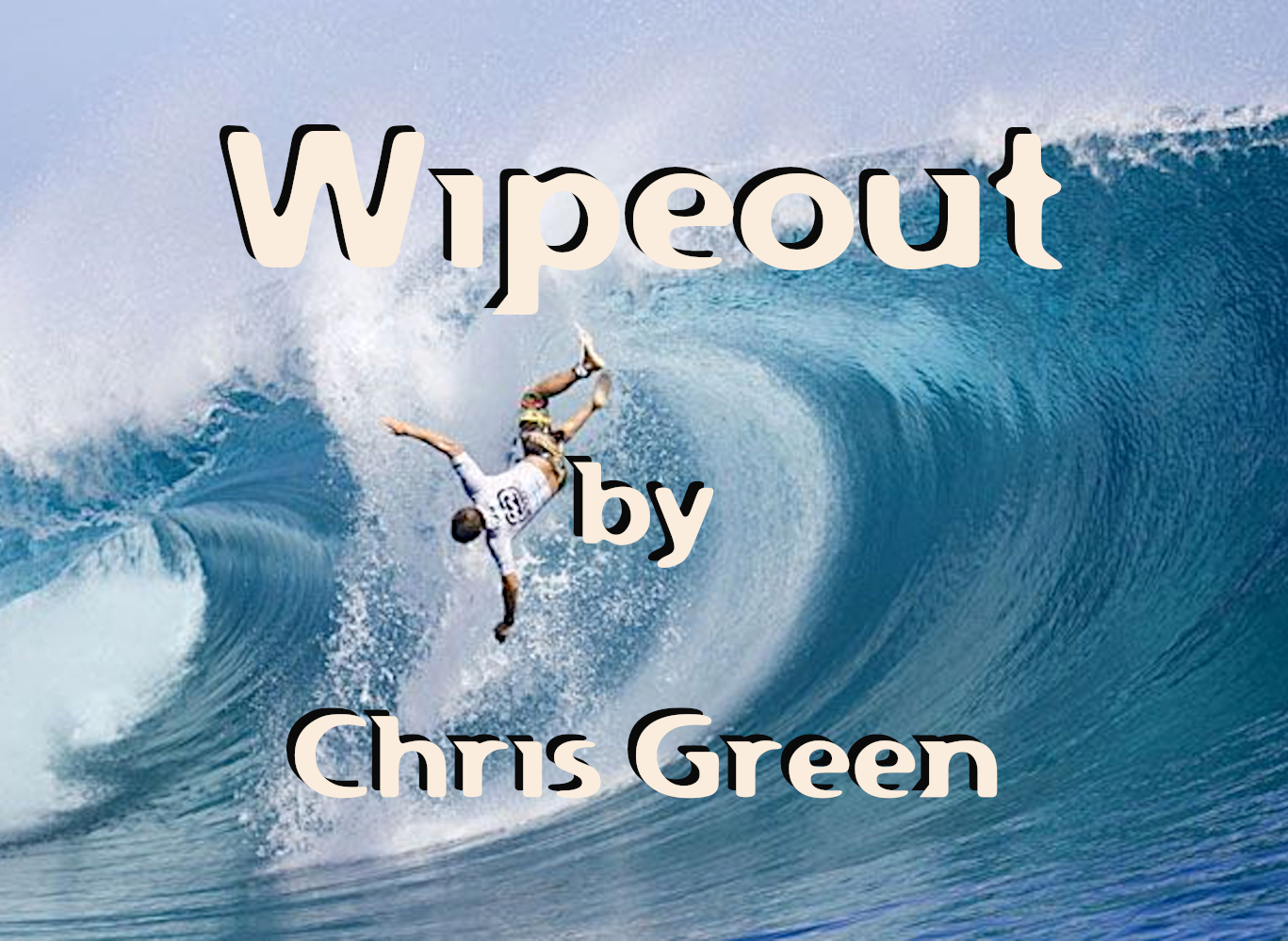
Wipeout by Chris Green
Most people in the UK associate surfing with Newquay, but Widemouth in North Cornwall was its original home. Widemouth is where the Australian pioneers of the sport came when they first arrived in the country to test the waters. Surfers will tell you that the bay has an easy paddle and peaks holding six to eight feet at mid to high tide. Black Rock at the southern end of the bay becomes wild in the winter months with a hollow and powerful reef break reaching ten or twelve feet on a good north-westerly swell. These huge waves were the main attraction for our Antipodean friends, who loved to show off their skills. Before his premature death in 1963, at the age of twenty-three, local lad, Gary Gray loved surfing here. Gary was able to negotiate the largest breakers with grace and dexterity. Crowds gathered on the beach in all winds and weathers to watch Gary surf.
No one knows the reason why one frosty night in December 1963, Gary took his Norton Dominator out on the windy coastal road. It was to be his last trip on the powerful machine. Big speeds, black ice and a brick wall saw to that. Some say that Gary had started taking amphetamines. But where he might have found amphetamines in rural Cornwall in 1963 is hard to say. His friend, Jago remembers a meeting Gary had with a dodgy looking geezer from out of town and wonders if this might in some way be connected with his fatal ride. People simply didn’t wear shiny silver suits in Bude. and no one had ever seen a narrow pink tie before. The fellow was clearly up to no good. What was he cooking up and where did Gary fit into it? Might he have been out of his depth with East End faces? But Jago says Gary courted danger. He modelled himself on James Dean. He literally thrived on risk. Might he even have harboured a secret death wish?
Recordings that have recently come to light that Gary Gray made on a reel-to-reel tape recorder shortly before he died show that he was also an ace musician. He sang and played lead guitar in The New, a band whose grungy chords were years ahead of their time, as was their name. Back then, group names were still plurals, The Shadows, The Drifters, The Ventures, etc. The New had somehow anticipated the trend for singular band names, The Who, The Move, Cream. Had they been based anywhere else but Cornwall, they would surely have made it big, but back then Cornwall was a cultural desert, hardly the best place for upcoming pop groups hoping to get noticed. Yet, someone from the music business must have come across The New. Perhaps a Soho impresario on holiday with his family in the south-west found himself at one of the gigs they performed in village halls and thought to himself, I’ll use this, because a year or so later The Kinks were playing one of Gary’s edgy riffs on You Really Got Me and soon after, Pete Townshend and Jeff Beck were using Gary’s feedback technique, passing it off as their own creation. The general public may not realise it yet but sixties rock and even heavy metal and punk owe a great debt to Gary Gray’s guitar strangling on those early recordings. The Troggs’ Wild Thing is easily recognisable from Gary’s, Wild Nights and Purple Haze is virtually a note-for-note copy of Gary’s, Hazy Days. On Gary’s death, the band, acknowledging that he had been the songwriter and driving force, split and persevered with their day jobs. With no traceable family, Gary’s name has all but been wiped from the record.
‘That’s what we have so far,’ Macy Reno says. With no films currently in production, Macy is trying to thrash out the screenplay for the new film with his screenwriter, Dirk Van Dijk. Having worked closely on the script, Dirk will already be aware of the details. Macy’s summary must be for my benefit. I’m Eddie Hacker, a rookie film editor sitting in to advise on possible continuity issues. I am new to the project and I’m not completely sure why I’m here. Normally a continuity editor wouldn’t be needed until after filming had begun.
‘Sure, it’s got surfing and music going for it but we are still talking rural Cornwall in the early sixties,’ Macy says. ‘And Joe Pub will not have heard of Gary Gray. Not going to pull them in, is it, Dirk?’
‘You don’t like what I’ve written?’ Dirk says. He has submitted numerous drafts now. I detect that all is not well between the pair. I say nothing. Let them settle their differences first.
‘To be honest, Dirk, the script is a bit ……. downbeat,’ Macy says.
I’m inclined to agree with him. In these days of CGI and superheroes, you need something sensational to sell a film. This is not the time to wheel out a plodding parochial drama.
‘Perhaps we should change the location to attract the big distributors,’ Macy continues. ‘What do you think? …… California?’
‘If you do that, you lose the story,’ Dirk says. ‘Surfing and California. Been done to death. Besides, the main focus here is surely the unlikely rural origins of the heavy guitar riff. We could concentrate more on the soundtrack.’
‘But we do need to big it up a bit,’ Macy says. ‘Come on now, Dirk. What have you got?’
They seem to be at odds with one another. Dirk writes dialogue, Macy wants pictures. Dirk writes realism, Macy wants surrealism. They are going round in circles. I’m thinking I might have a go at something myself. …….. I know how to research and I did a degree in Creative Writing. OK, I didn’t finish it, things got in the way. But, I’ve had dozens of stories published in Schlock magazines. I’m not sure how I ended up in film editing. It’s not where my heart is. I’d rather be writing. It would be nice to have a screenwriter’s credit.
‘What about a sliding doors moment?’ Dirk says. ‘A pivotal scene where the plot could go one way or the other. And then we could run the two narratives alternately.’
‘Perhaps more of a forking paths moment.’
‘Isn’t that the same thing?’
‘Not really. I’m thinking of a Borges scenario.’
‘Hey?’
‘Jorge Luis Borges, the writer of Labyrinths. His story where the protagonist comes to a fork in the road and instead of going one way or the other takes both paths simultaneously. Perhaps we could keep forking the paths and have endless split screen shots.’
‘Might be a hard slog ….. well, for me, the writer, for instance.’
I am thinking Dirk should count himself lucky, it will be a harder slog for me, the editor. Hopefully, Macy will realise the impracticalities. When you read a novel or indeed a work of non-fiction, if there is still such a thing in these post-truth times, and then see a film based on the book, you notice subtle differences. You may prefer the novel. Or you might prefer the film. Most people are likely to say they prefer the novel. The director’s job is therefore not easy. He has to condense the novel into an acceptable length for the film so he needs to be creative. This can make an arty director like Macy Reno, who relies on his eccentricity, more prone to flights of fancy. Not that flights of fancy are altogether a bad thing. But, at the same time as being creative, the director needs to keep it simple. The attention span of cinema-goers today is slight. You need to put in some narrative redundancy so they can check their phones. I recommend a comic book approach.
‘Or he could have a doppelgänger or a series of doppelgängers,’ Macy says. ‘Split screen would work here too.’
I’m thinking split screen is hopelessly dated. An innovative director like Macy must realise he needs to move with the times. ……. There again, perhaps it would help give a retro feel to the film.
‘And being Cornwall,’ he continues. ‘We could maybe have Gary drawn into a sinister cult of fly agaric mushroom worshippers.’
‘Didn’t you do something like that in the last film?’ Dirk says. ‘The one about the exploding hedgehogs.’
‘Turbulence wasn’t about exploding hedgehogs. There was just a scene in it where a hedgehog explodes. And it was central to the plot. Anyway, that was a cactus worshipping sect.’
‘Yes, I think I remember now. It was all to do with that sinister high-pitched hum that was spreading across the country.’
‘If you remember, the sound was the rotation of the earth slowing down.’
‘Perhaps it was misleading to advertise it as being based on a true story.’
If you ever come across the phrase, based on a true story, in relation to a film, read it as bears no resemblance to the original. Whatever the genre. This is one of the first things you learn in Film Appreciation 101.
‘Or maybe the villagers could be pagan cultists,’ Macy continues. ‘You know like The Wicker Man. Always appears in the top ten British films, that one.’
‘I suppose you are talking about a small rural community at a time when there was not much going on,’ Dirk says. ‘It’s the right setting, but …… ‘
‘What about vampires? They are always good box office.’
‘Didn’t you have vampires in In the Dead of Night?’
‘No. That was zombies. I’ve never had vampires.’
‘You know, Macy. I’m wondering if perhaps we’ve got enough of a story already,’ Dirk says. ‘We’ve got a dazzling surfer, not to mention the musician who gave us modern rock music,’
Dirk has hit the nail on the head. Certainly, we need to emphasise the dark parts more, bring in a menacing villain or two and big up the love interest, but let’s keep to the point. Leif Velásquez displayed similar hyperbolic tendencies when I was working with him on Friday the Thirteenth. He suggested we run the filmed footage backwards and not in a Benjamin Button kind of way. The film would have been a box office disaster. For his epic State of Mind, I had to talk Leif out of using Heisenberg’s Uncertainty Principle to plot the action. Great idea, but too highbrow. Arthouse doesn’t bring in the dosh.
As Macy and Dirk don’t seem to be able to agree on anything, I decide to get cracking on research towards my own screenplay. It doesn’t start well. I discover that Macy has been sitting on the project for years and most of those who might remember Gary are now dead and gone. Mrs Trescothick from the Women’s Institute remembers him as a shy boy who used to talk to cats and his old schoolmistress, centurion, Miss Penhaligon says he used to masturbate in class. None of his surfing contemporaries are around and I find nothing that sheds fresh light on Gary’s fatal ride. For all I know, he may have been riding a moped. Or not gone out at all. While surfing is still going strong in Widemouth, all that is left to remember Gary’s efforts are a few black and white photos on the wall in a Widemouth beach café and these grainy images could have been of any surfer. I can see why Macy did not want to run it as it was. It would have been dull. Nor do I manage to find out how Gary’s songs got into the wrong hands. Nor is there any proof that he actually wrote them. No choice then but to embellish the story. Start from scratch even.
Then I have a stroke of luck. It seems far more sinister things were happening in the pop world than a few of Macy’s tunes being copied. News is breaking that many of the big hits back then were hyped up the charts by Wardour Street racketeer, Vito Gunn. Vito arranged for his associates to buy dozens of copies from each of the stores that put in returns for the charts up and down the country but he quickly realised that on a weekly basis this could become expensive so he dispensed with this nicety. Instead, he told the stores what numbers to put into their returns with the threat of sending in the boys if they didn’t. It worked. He only had to send the boys in once. Acts as unlikely as Brian Poole and the Tremeloes or The Dave Clark Five had number-one hits. I mean, Glad All Over, really!
Hyping worthless tunes by talent-free groups up the charts became standard practice in the mid-sixties. Vito and a fellow racketeer who went by the name of Maltese Fred had the market sewn up. Between the two of them, they dictated what was played on the radio and who appeared on TV pop shows. The only surprise is that given the throwaway nature of some of the number one hits the story has taken so long to come to light. Surely people must have had their suspicions that something was amiss.
But, what about Gary Gray’s tunes being stolen? This is not quite the same. I have actually heard Wild Nights and Hazy Days. They were transformed into Wild Thing and Purple Haze. Whether Gary actually wrote them or not, these were important developments in rock music. Might Vito Gunn have been the mysterious geezer from out of town that Gary’s friend Jago referred to? We may never know but it hardly matters if it isn’t true. Vito is dead now. Alternatively, we could just make someone up. I’m pretty sure we will be able to create a credible character profile of a morally bankrupt sixties music mogul. A gun-toting Soho kiddie-fiddler perhaps or a Neo-Dickensian Reggie Kray. The badder the better. After all, it’s villains that put bums on seats in cinemas these days as much as heroes. Think Darth Vader, The Terminator, Hannibal Lecter. If you have a goodie in a movie then for balance you are going to need a baddie. It’s rule one of drama.
Macy phones to tell me that Dirk is off the film. Irreconcilable differences, he says, Dirk’s just not adventurous. I tell him not to worry, I have some ideas. I already have the music part of the film sketched out, I tell him. He is excited by my new discoveries about the sixties underworld and says we can definitely factor the gangland corruption into the script. We arrange a meeting. If there’s one thing I’ve learned from working with Macy Reno and Leif Velásquez, it is that truth has nothing whatsoever to do with movie-making. It gets in the way. You can write whatever you want about anyone, dead or alive and make a film of it. No one is going to come after you with lawsuits. Not even the Royals. Look at all those potentially libellous films about them and not a dickie bird.
Carte Blanche, then. I sketch out a script where our young British rock and roller gets fleeced by transsexual Bethnal Green gangster, Vito Gunn then in a turf war is taken out by Maltese Fred’s hitman, Stanislav Ruby. All I need to do now is introduce the demon surfer from Hell, the badder the better, to spar with our protagonist and add a little love interest, perhaps a salacious, suntanned Californian Baywatch babe who just happens to find herself marooned in nineteen-sixties Cornwall after a time travel experiment went wrong.
By the time I am finished, I will have transformed a forgotten Cornish surfer who wrote a couple of grungy rock songs and may or may not have crashed his bike on a dark night in December into a legend of biblical proportions, a veritable superhero with arcane powers. Gary’s death then would be by no means the end. I could leave room for his mystical return in a sequel. Maybe later we might turn it into an adult cartoon series. Gary Gray could become a comic book hero. Fortunes are made from small beginnings. You have to speculate to accumulate. You are probably beginning to notice the Gary Gray merchandise in the shops. There will be a whole lot more when Wipeout opens next year.
Copyright © Chris Green, 2024: All rights reserved

 Chris Green Stories